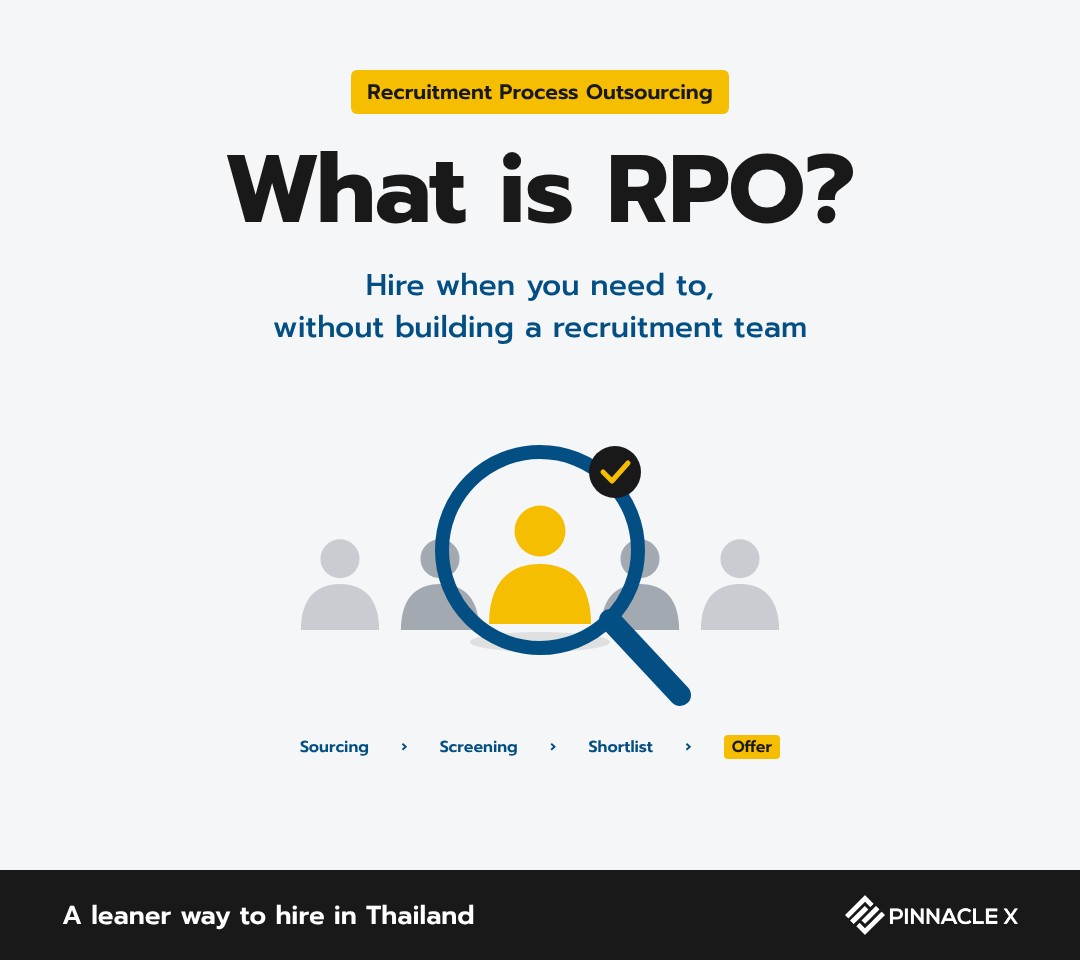
Recruitment Process Outsourcing (RPO) is a form of outsourced recruitment in which an outside team manages all or part of your hiring process as an extension of your HR. Your company stays the employer and retains final hiring approval. RPO can support an existing HR or recruitment team, or take on the recruitment work for companies that do not have one. For companies in Thailand moving to a leaner structure, it adds recruitment capacity without requiring you to build a dedicated in-house team.
Why consider RPO when hiring needs change?
When hiring needs change from quarter to quarter, maintaining a dedicated recruitment team can be difficult to justify. You may need ten people this quarter and one person next quarter.
Employing an in-house recruiter brings ongoing costs, including salary, benefits and employer contributions, even during quieter hiring periods. Recruiting and onboarding that person also takes time and resources. If they leave, finding and training a replacement can disrupt hiring, and managers may need to explain the same open roles again, which can be frustrating and slow things down.
RPO support can be scaled to your hiring plan, as agreed in the service scope. For repeat hires, the team can build on previous role briefs and screening criteria, updating them with you as requirements change. This helps reduce repeated briefing work.
What does an RPO partner do?
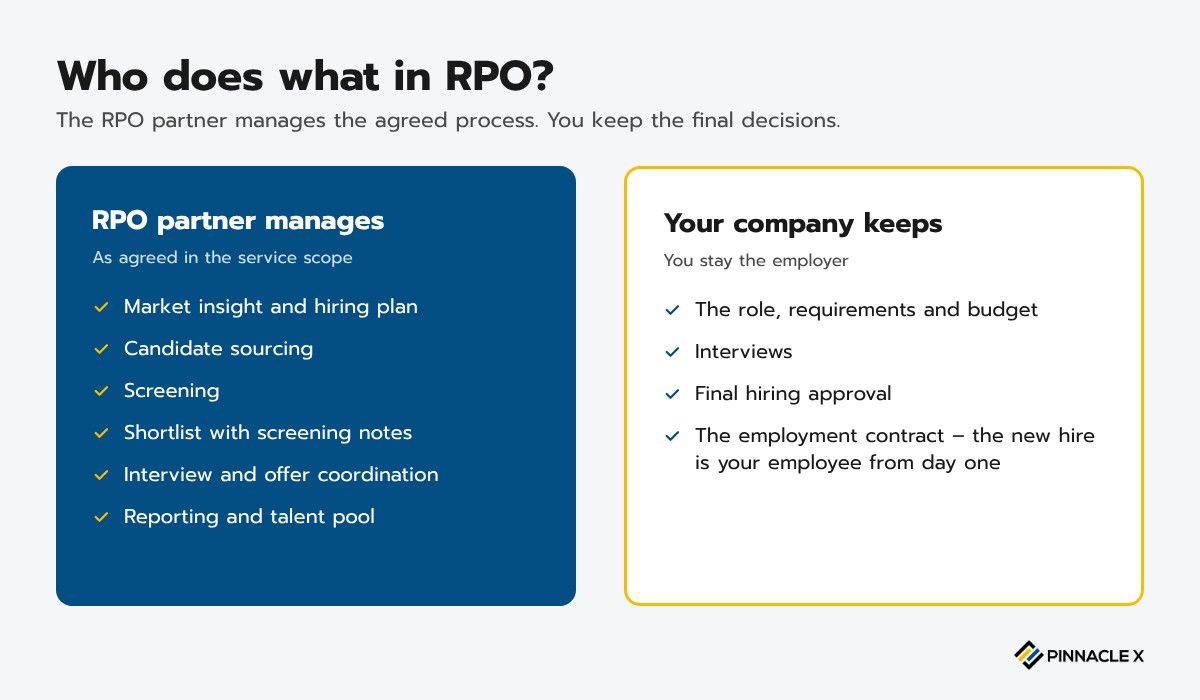
The scope is agreed with you, but a typical RPO service covers:
- Market insight and hiring plan – talent availability and salary benchmarks for the role
- Candidate sourcing – job channels, professional networks and direct outreach
- Screening – qualifications, experience, relevant language skills (including English where needed) and role fit
- Shortlist – profile summaries with screening notes to help managers assess candidates before interviewing
- Interview and offer coordination – scheduling, feedback and follow-up through to acceptance
- Reporting – pipeline updates and market feedback
- Talent pool – pre-screened candidates kept for your future roles, as part of the agreed scope
What stays with your company?
- Defining the role, requirements and budget
- Interviewing candidates and giving final hiring approval
- Issuing the employment contract – the new hire is your employee from day one
In short: the RPO partner manages the agreed process, and you keep control of the final decisions.
RPO, recruitment agency or staff outsourcing: what is the difference?
These three services are often confused, partly because “outsourcing” can refer to different services. In Thailand, the term is often used for contract staff, so it helps to separate recruitment support from staff outsourcing. The key difference is who takes responsibility for what. An RPO partner manages an agreed recruitment process. An agency engagement typically focuses on filling specified vacancies. Staff outsourcing provides workers who are employed by the provider. In practice, services and fees can overlap.
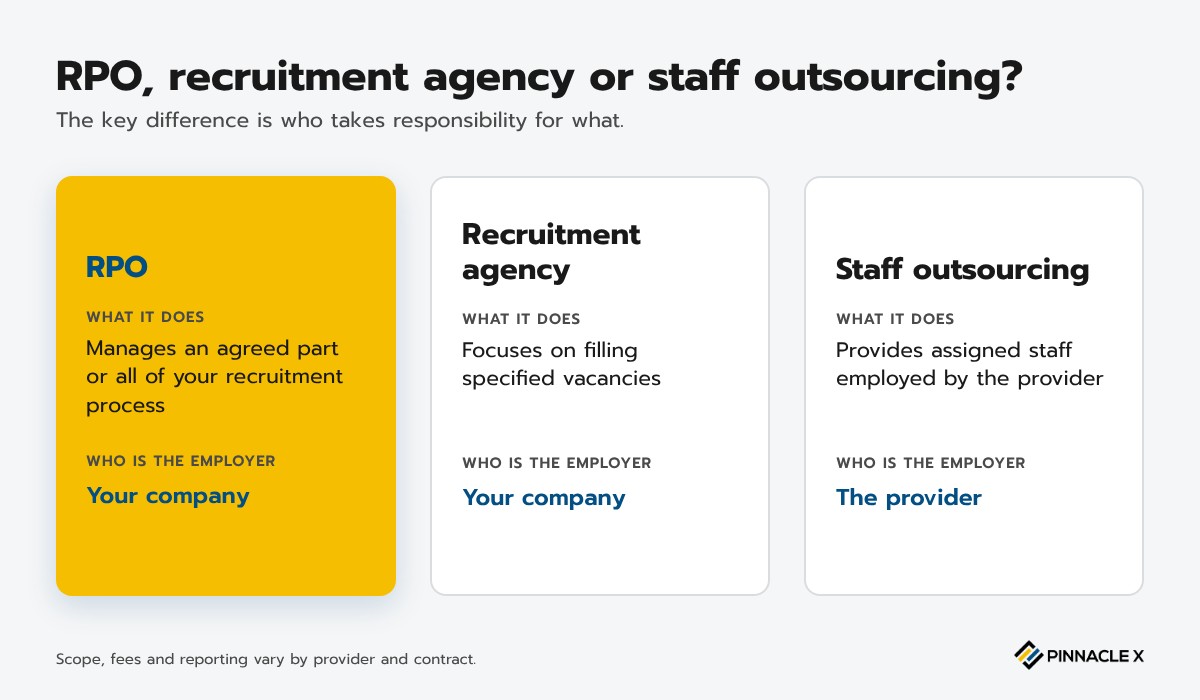
Swipe left to compare all services →
| RPO | Recruitment agency | Staff outsourcing | |
|---|---|---|---|
| What you get | A partner that manages an agreed part or all of your recruitment process | Candidates for specified vacancies | Staff assigned to you and employed by the provider |
| Who employs the new hire | Your company | Your company | The outsourcing provider |
| How it is usually charged | An agreed service fee based on scope | Usually a fee per successful hire; some work on retainer | A monthly service fee for assigned staff |
| Reporting | Agreed pipeline reporting and process updates | Candidate updates and reporting agreed with the agency | Recruitment and workforce reporting agreed with the provider |
| Often used for | Ongoing or multiple hires, new teams, lean HR structures | Specific or occasional vacancies | Temporary or outsourced workforce needs where the provider employs assigned staff |
Scope, fees and reporting vary by provider and contract.
In-house recruitment team or RPO?
It does not have to be one or the other. An in-house team may suit steady hiring needs and close day-to-day involvement in the business. RPO can support ongoing hiring or a defined project, either alongside your own recruiters or as your outsourced recruitment function.
For companies that hire in waves – a new branch, a new project, a replacement for a key person – RPO provides a structured process without adding permanent headcount. The level of support can be adjusted as plans change, within the agreed service scope. Compare the workload, the complexity of the roles, the cost and the level of support you need.
Is RPO right for your company?
RPO is worth considering if:
- You do not have a recruitment team at all, so hiring falls to managers or HR on top of their other work
- Your hiring needs are not steady through the year – a busy period with several roles to fill, then only a handful for the rest of the year
- You only need recruitment support on demand, so setting up a full-time recruitment team is hard to justify
- Your in-house recruiters change often, and hiring slows down each time someone leaves
- Your HR team is stretched across payroll, employee relations and administration
- You are opening a new office or store, or building a first team in Thailand
- You want a clear, consistent hiring process across departments
- You want to build a pool of candidates before the need becomes urgent
For a single straightforward vacancy, an agency or your own internal hiring process may be enough. The right model depends on the work involved and the agreed fees. We will look at these signs in more detail in the next article in this series.
How Pinnacle X can help
Pinnacle X Outsourcing provides Recruitment Process Outsourcing in Thailand for local and international companies, with experience across luxury retail, corporate and technical roles. We offer three models: monthly recruitment outsourcing, project-based recruitment outsourcing, and full-cycle recruitment for a small number of key roles. If you also need HR or payroll support, we can provide that as well.
Tell us the roles you need to fill and your hiring timeline, and we can discuss a suitable scope. Learn more on our Recruitment Process Outsourcing page, or contact us for a free consultation.
Frequently asked questions
What is RPO?
RPO (Recruitment Process Outsourcing) means outsourcing all or part of your hiring process to an outside team that works as an extension of your HR. Your company remains the employer and retains final hiring approval.
How is RPO different from a recruitment agency?
An agency typically focuses on filling specified vacancies. An RPO partner manages an agreed part or all of the recruitment process, with defined responsibilities and reporting. Services and fee models can overlap.
Who employs the new hires under RPO?
Your company does. RPO covers the hiring process only. If you need a provider to employ staff on your behalf, that is Staff Outsourcing or Employer of Record.
Is RPO only for large companies?
No. Project-based and full-cycle models can suit small and mid-sized companies that hire in waves and do not need a full-time recruitment team.
Can we use RPO for just a few roles?
Yes. Depending on the role and scope, full-cycle recruitment can cover a small number of key roles.